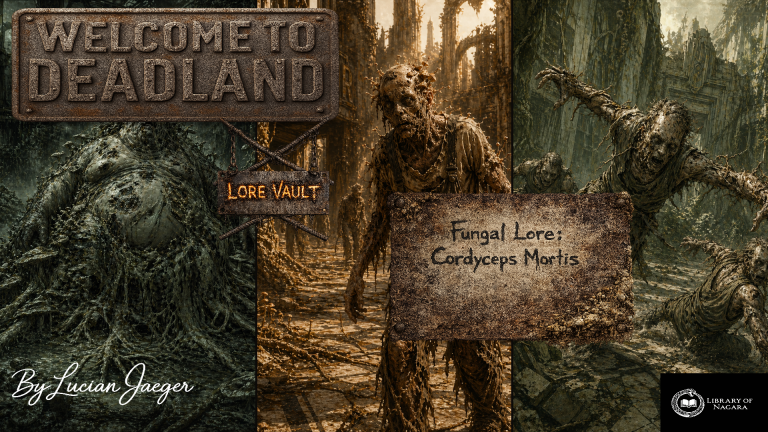
Cordyceps Mortis: Infection, Evolution, and the Deadland Ecosystem
Cordyceps Mortis is the defining parasite of the Deadland, but it is often misunderstood by city-folk, rookies, and anyone unfortunate enough to mistake surface behavior for the full truth. It is not a simple disease, nor a true hive mind in the way frightened people imagine. It does not think like a person, command like a king, or plan like a general. In the strictest sense, it does not understand anything at all. It invades, records, reads, repurposes, consumes, and grows. Every infected body is shaped by the host it steals, the environment it matures in, the amount of fungal mass transferred during infection, and the primal impulse driving that form. A wolf remains a wolf. A soldier may still protect his head. A trained fighter may still swing a weapon. A low-awareness drifter becomes useful in a different way than a disciplined mercenary. The parasite does not create identity. It strips identity down to instinct, muscle memory, emotional imprint, sensory association, and useful biological pattern, then drives those remnants toward fungal purpose without ever knowing what those remnants meant.
Cordyceps Mortis spreads through three primary infection vectors: bites, scratches, and spore inhalation. Bites are the most common and most reliable route. When an infected sinks its teeth into living flesh, active fungal hyphae transfer through saliva, torn tissue, and contaminated fluids. A shallow bite may not carry enough fungal mass to overwhelm the body, especially if treated quickly, but a deep tearing bite can flood the wound with active filaments and make infection nearly inevitable. Scratches are less reliable, but still dangerous when deep enough to breach muscle, blood vessels, or major tissue layers. A glancing scratch may leave only dead spores or surface irritation, while a gouge from a heavily infected claw can deposit enough active material to begin systemic spread. Spore inhalation is the deadliest vector in dense fungal zones. In open sun and moving air, spores thin out, dry, and often die before they can take root. In damp darkness, ruined basements, sealed corridors, fungal nests, collapsed tunnels, and mega-city interiors, spores thicken into lethal clouds. A single deep breath in the wrong place can deliver enough fungal mass to begin rapid takeover.
Infection is not merely a question of contact. It is a question of threshold. Cordyceps Mortis requires enough viable fungal mass to overcome the body’s defenses and begin rooting itself through tissue. A small exposure may become localized rot, fever, pain, and scarring without full transformation, especially if treated early with the right medicine. A large exposure allows the parasite to move from wound to blood, from blood to nerves, and from nerves toward the brain. Once it breaches the brain barrier and begins integrating with the central nervous system, recovery is no longer possible. The early window is short, brutal, and often wasted by denial. Fever, itching wounds, coughing, trembling, and eye discoloration are warning signs, but by the time speech begins to slur and the eyes grey, the person is usually already lost.
The transformation progresses through recognizable phases. First is incubation, when the host remains functional but the wound burns, itches, swells, and begins to change beneath the skin. Next comes rooting, when hyphae spread through tissue, blood, nerves, and lymph, producing tremors, fever, blurred vision, aggression, and the first signs of neurological disruption. After that comes takeover, when the parasite begins piloting the host through the nervous system. During this period the victim may still be alive in a biological sense for a time, but no longer fully controls the body. The fungus is inside the meat, pulling strings. Finally comes reanimation and maturation, when the host becomes one of the infected forms. Which form emerges depends on fungal load, host imprint, environment, and whether the infection develops on the surface or underground.
Cordyceps Mortis operates through four primal impulses: Spread, Consume, Facilitate, and Preserve. The most common surface infected are driven mainly by Spread and Consume. They seek bodies, moisture, movement, and opportunities to create new fungal growth. More advanced underground forms are driven more strongly by Facilitate and Preserve. They coordinate movement, defend territory, protect fungal mass, and move viable hosts into environments where the parasite can mature properly. These impulses are not thoughts in the human sense. They are biological directives filtered through stolen instincts. When an infected appears to eat, it may not be feeding in the human sense at all. A Runner tearing into flesh may be executing a hydration behavior: the parasite needs moisture, the host imprint associates eating with wet mass and nourishment, so the body consumes. Consumption is irrigation.
The parasite’s development can be understood through three broad stages: Puppet, Oneness, and Master. In the Puppet stage, the fungus is inside the host and controls it from within, but the host remains mostly a vessel. Shufflers and Slumpers belong to this stage. The host is moved, delayed, rooted, or bloomed according to fungal need. In the Oneness stage, the fungus and host imprint have fused more deeply. The parasite can access muscle memory, aggression, social patterning, learned movement, emotional association, and reactive behavior with greater efficiency. Runners and Soldiers belong to this stage. A former boxer may still strike. A former scout may still flank. A former soldier may still guard the head. The fungus does not understand those skills as a person would; it reads them like a machine reading a punched card. At this stage there is still lag, because the parasite is using the remaining human brain as a living reference library. It may feel the host’s anger, see flashes of images, or trigger trained responses, but it does not comprehend them. It only registers pattern and executes. In the Master stage, the host has been drawn so deeply into fungal architecture that the body is less a stolen person and more a specialized organ of the territory. By then the human brain has been consumed and replaced by fungal mass storing usable patterns for execution. There is no person left and very little delay. Ghouls, Lieutenants, and higher underground forms belong to this deeper stage, though not all such forms are publicly documented or understood.
The most numerous infected are Shufflers, and they are often mistaken for aimless dead. In truth, a Shuffler is best understood as a seed that has not yet found soil. Under sunlight, wind, heat, and dry surface conditions, fungal growth slows and delays itself. The body wanders in what appears to be pointless hunger, but the parasite is conserving potential until the Shuffler can be driven into a better environment. Runners herd Shufflers toward damp, dark places where maturation can continue. Once there, a Shuffler may become a Runner if the host carried enough reactive awareness, social momentum, movement, and survival imprint in life. If the host carried low awareness, low motivation, and little independent drive, the Shuffler is more likely to become a Slumper.
Slumpers are not failed infected. They are the bloom. A Slumper is what happens when a low-awareness host becomes more useful as fungal infrastructure than as a mobile hunter. Slumpers root into damp darkness, swell with fungal mass, and become living nest-growth. Their bodies help expand territory, exhale spores, anchor fungal mats, and turn ruins, tunnels, basements, and wet hollows into fungal home. Bloated, slow, half-collapsed things fused to walls, floors, or soil, setting them on fire? They also explode like a shrapnel bomb if in low moisture enviroments.
Runners are the next major surface form. They are faster, more reactive, and more socially organized than Shufflers. Their function is to herd. Runners act like sheepdogs for the fungal mass, driving Shufflers toward wet dark and maintaining loose control over local infected movement. Their behavior comes from reactive awareness rather than higher strategy. In life, such hosts were often energetic, socially responsive, clique-bound, or quick to act without necessarily possessing deeper self-direction. In death, that becomes pack behavior. Runner packs coordinate internally in groups of 3 to 5, but separate packs do not naturally unify. Like human social cliques, each pack has its own rhythm and preference. Without a higher-order infected directing them, they remain dangerous but locally limited.
Soldiers are the basic tier of advanced underground infected and are always matured below the surface. They do not form properly in ordinary surface conditions because sunlight, dry air, weather cycles, human interference, and environmental instability distort the process. Underground maturation is different. In tunnels, caves, subways, bunkers, storm drains, buried utility routes, and damp sealed spaces, the parasite has stable darkness, stable moisture, and enough time to cultivate the host correctly. Soldiers usually arise from hosts with higher awareness or disciplined imprint: military personnel, Deadlanders, mercenaries, trained fighters, survivalists, shepherding personalities, or people whose instincts favored coordination under pressure. Their primary impulse is Facilitate, with Preserve as a secondary function. When underground population mass reaches a threshold, Soldiers are compelled upward to organize expansion. They coordinate Runners, and Runners coordinate Shufflers. What looks like a sudden horde is often the visible surface of a deeper logistical movement impulse. A Soldier may appear to dodge or defend itself, but the behavior is not true understanding. Strike its head with a club and it may raise an arm at the moment of impact. Fire a gun in its face and it may flinch or shift in response to the bang, flash, pressure, and gas. Give it a weapon and it may swing with fragments of trained response, often crude, violent, and delayed. The parasite is still reading the host brain in real time, and that reading creates lag.
Lieutenants are a more complete underground command form, more efficient than Soldiers and far more dangerous in close quarters. By the time an infected reaches this stage, the parasite has consumed the human brain as a person-bearing organ and replaced it with fungal mass that stores executable patterns. A Lieutenant can perform crude problem-solving and may fight with what looks like technique, depending on how deeply those skills were imprinted in the host. The difference is speed. Where a Soldier reads and reacts with delay, a Lieutenant executes without lag. If the host had strong reference patterns for being struck at the head, the Lieutenant may register the attack and move before impact. If the host never carried that reference, it may fail to respond at all. The parasite does not reason its way to a defense. It can only execute what the host’s life gave it.
Ghouls are advanced underground hunter-killer forms and serve a different purpose from Soldiers. If a Runner is a sheepdog and a Soldier is a shepherd, a Ghoul is a hunting dog. Ghouls are more fungus than surface infected and are more sensitive to sunlight. They usually emerge at night, during storms, or under conditions where cloud, rain, darkness, and noise conceal their movement. Their purpose is retrieval and territory preservation and yes they also hunt in packs. The well-known “tap tap tap” behavior associated with Ghouls is not mindless creepiness. It is a field test. A Ghoul checks whether a fallen body is still alive. If the survivor is viable, the Ghoul drags them underground, where the tuned habitat can use them. The horror of a Ghoul is not simply that it kills. It is that it may decide death is wasteful. Ghouls can also recognise human habitation, they do this by the fire glowly of barrels used for burning of spore haze in enclosed spaces to keep air breathable, and when infected don’t normally knock? What is the first human instinct to some on knocking on your door with a “tap tap tap”? This is also why ghouls are largely unknown, almost no one survives them and those who do don’t have anything but a “tap tap tap” sound to go by.
Children follow a different infection line because their bodies, instincts, and imprint differ from adults. The basic child infected is the Howler. Howlers are skittish, agile, and generally more useful as sentries than direct attackers. They perch, hide, flee, and scream when intruders approach nests or fungal territory. Their shriek alerts nearby infected and can turn a quiet ruin into a kill zone. Some Howlers develop into Mimics, low-energy lures that copy sounds, voices, pleas, and fragments of prior victims. A Mimic does not understand grief or mercy. It uses the sounds the host or its victims left behind, turning compassion into a trap. From the Mimic line can come Banshees, which weaponize sound more aggressively, producing screams that disorient, mask approaching infected, and break a survivor’s ability to track danger by hearing. Sleepers are another Mimic-line development, burying themselves into fungal growth with adaptive coloration and soft calls that lure prey close. They are difficult to see in the dark, but rapid changes in light can reveal them before they adjust.
The Goblin line represents the high-energy child variant. Goblins are pack skirmishers, ambushers, and defensive nest fighters. They move in groups, leap with frog-like bursts, and overwhelm prey through speed, confusion, and numbers. Where Howlers warn, Goblins harass. Where Mimics lure, Goblins spring. In deeper underground conditions, Goblins may mature into Gremlins, smaller pack fighters that often accompany Ghouls. They are not commanded by Ghouls in the same way Runners may be coordinated by Soldiers, but they naturally follow the violence of larger underground hunters like how children follow much older siblings around, adding confusion and pressure while the larger form does the decisive work.
Animal infected prove one of the most important truths about Cordyceps Mortis: the parasite is one strain, but the host changes the expression. Animals still act like animals because the fungus hijacks instinctual imprint. Wolves remain pack predators. Bears become siege-brutes. Dogs may become smaller Runner-like hunters. Livestock become dangerous but usually less coordinated fungal husks. Larger animals, especially predators, can become Specialized forms because their bodies and instincts give the parasite stronger tools. Infected wolves fight human infected for territory because wolf logic remains territorial and pack-driven. They are not loyal to human dead simply because the same fungus moves them. Cordyceps Mortis does not create perfect unity. It creates fungal purpose through stolen instinct.
Domesticated animals are among the most quietly tragic expressions of this rule. A pet dog that becomes infected does not necessarily lose the imprint of loyalty. The parasite reads the same pathways it reads in every host, and in a domesticated animal those pathways may include following humans, guarding familiar bodies, trailing a household, or attaching itself to a wandering infected that resembles its former pack. Such infected pets often become scavengers, escorts, or guard-dogs to infected groups. They may pad beside Shufflers, linger near a human infected they have bonded to, or defend a territory with the same devotion they once gave a home. The fungus does not understand loyalty, love, fear, anger, or grief. It only uses the shapes those things carved into the host.
Water shapes the entire Deadland ecosystem. Cordyceps Mortis thrives in damp darkness, which makes fresh water sources especially dangerous. Rivers, lakes, wetlands, flooded basements, cisterns, and old drainage systems attract animals, preserve moisture, and create shaded environments where fungal growth can accelerate. Fresh water fish can become contaminated or infected, making inland fishing dangerous. Wild animals gather near water, become infected, and then draw more danger into the area. Where there is fresh water, there are animals. Where there are animals, there are animal infected. Where animal infected dominate, humans avoid the source. Over time, fresh water becomes less a resource and more a trap ecosystem.
Saltwater is different. Cordyceps Mortis struggles in high-salinity environments, and exposed fungal tissue reacts badly to saltwater and brine. Salt does not repel infected instinctively; they will walk into a jet of saltwater as readily as a freshwater spray. The reaction comes after contact, when the exposed fungal material shrivels, burns, or weakens. This makes salt and brine essential tools, especially for coastal cities. Saltwater fishing provides a safer food source than freshwater fishing, while brine can be used in livestock washing, gate defense, and fungal control. Some cities spray animals with hot and cold saltwater. Others vent heated brine steam into the air to kill air born spores. Inland cities with less access to saltwater often rely more heavily on fire, heat, dry barriers, and controlled burns.
The cities themselves exist inside a false sense of control. The walled cities were not designed after the Collapse as perfect anti-fungal fortresses. Most were already there: satellite cities, tourist hubs, industrial zones, commercial centers, and agricultural districts connected to the old mega-cities. They survived, walled themselves, adapted what they had, and developed local methods for holding the Deadland back. Some use brine. Some use fire. Some use steam, lamps, sealed drains, livestock treatment, and brutal population control. Yet many city systems still feed the wider fungal ecology without caring enough to see it. Expelled populations become potential fungal mass beyond the walls.
The greatest mistake is believing the surface is the Deadland. Most surface infected are spillover from what grows below. Beneath the continent lies a vast underground network of subway systems, caves, utility tunnels, storm drains, bunkers, old service corridors, collapsed basements, mines, sewers and fungal-threaded passages. This underworld provides the parasite with its tuned habitat. Surface infection is wild growth. Underground infection is cultivated growth. That is why Soldiers are underground-matured. That is why Ghouls drag viable bodies below. That is why mass movements can seem to appear from nowhere. The infection is not merely wandering across the land. It is moving through the land’s buried veins.
Mass movement and territory defense are related, but not the same. Mass movement is often quiet. When underground fungal population reaches threshold, Soldiers surface to facilitate localised expansion faster than normal. Runners herd Shufflers. Shufflers are moved toward new wet dark. Slumpers bloom. Territory expands slowly normally enough that many people fail to notice until a road becomes unlucky, a ruin becomes silent, or a familiar route begins taking lives. Fungal territory defense is not quiet. It happens when humans create sustained noise and vibration inside fungal ground in large enough numbers. Hammering, digging, engines, gunfire, heavy wagons, mining, collapsing stone, and construction all teach the underground that something has rooted above it.
Noise and vibration matter because few things in the Deadland create them for long. A lone traveler will pass unnoticed. A temporary caravan may survive if it keeps moving. An outpost under construction is different. The first nail is only noise. The hundredth nail is a pattern. A sustained pattern becomes a location. A location becomes a target. The fungus responds through the under-network. Soldiers pool infected below. Runners gather Shufflers. Ghouls rise when the disturbance is worth hunting. Then, usually at night or during storms, the mass comes up. Soldiers lead the tidal wave. Runners keep the Shufflers moving. Ghouls use the horde as cover to test the fallen and drag the living underground. By morning, the disturbance is gone, and over time the mass ebbs back below through the fungal network.
Storms are especially dangerous because they combine the conditions Cordyceps Mortis needs. Cloud cover weakens sunlight. Rain wets the ground and fungal tissue. Thunder, wind, and heavy rain fill the world with vibration. Surface infected become agitated, and deeper forms are drawn upward by the noise and cover. Deadlanders know storms are not simply bad weather. They are open doors. The Deadland does not sleep. It dozes. That means it is always dangerous, always growing, always waiting beneath quiet roads and ruined stone. But it hates being disturbed. When the ground is shaken long enough for the parasite to notice, the Deadland stops dozing and answers the door.
The ecosystem of Cordyceps Mortis is therefore not a chain of monster types. It is an ecology of stolen bodies, stratified awareness, environmental pressure, and fungal purpose. Shufflers are seed-mass. Slumpers are bloom and nest-growth. Runners are sheepdogs. Soldiers are shepherds of expansion. Lieutenants command soldiers and are faster command forms with cleaner pattern execution. Ghouls are hunting dogs of the underground. Howlers are alarms. Mimics are lures. Banshees are sound weapons. Sleepers are hidden traps. Goblins and Gremlins are skirmishers. Animal infected are host-instinct expressions of the same strain. Fresh water becomes a trap, saltwater becomes a lifeline, cities become walled compromises, and the underground becomes the true body of the Deadland.