Power Systems in the Deadland
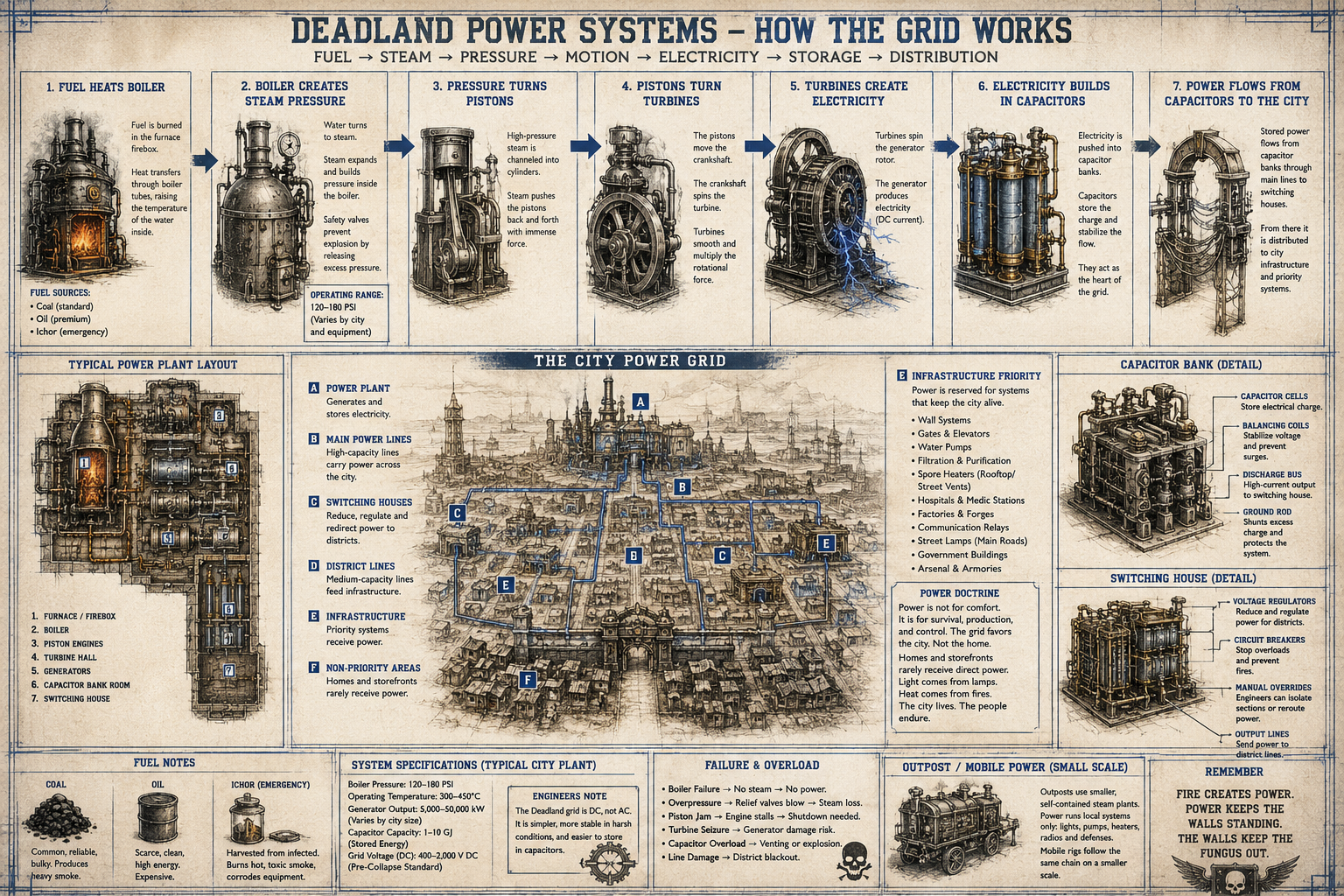
Power in the Deadland runs on steam combined with electricity. From steam trucks to cities, fuel gets burnt, boilers create steam pressure, pistons turn turbines to create electricity, which flows into capacitors, which then flows into the city or through the vehicle. Battery tech is lost tech in Deadland. In Pre-collapse Anvil, batteries were a thing. That tech was lost with the collapse; however, Techport is “working on it.” Homes in Deadland have no power, nor do storefronts. Power is reserved for infrastructure and industry. The street lights may be on, the anti-spore heater on the roof may be humming softly above your house, but that doesn’t mean the average house has it too.
Major Power Sources
Coal
Coal is the backbone of Deadland power. It is bulky, dirty, visible from a distance when burned, and dangerous to transport through hostile territory, but it is reliable enough to keep boilers running and infrastructure alive.
Charcoal and Wood Fuel
Charcoal and wood are common fallback fuels, especially for smaller settlements, poor districts, and outposts with limited trade access. These fuels are less efficient than coal but easier to produce locally. Forested cities make a killing selling wood and charcoal.
Oil
Oil is rare, expensive, and prized. It burns hotter and cleaner than coal, making it valuable for high-priority machinery, long-distance travel, stealthier movement, and wealthy or militarized city infrastructure.
Infected Ichor
Infected ichor can be burned as an emergency fuel. It produces intense heat but carries severe risks: toxic smoke, fungal residue, boiler fouling, contamination hazards, and you’ll stink for weeks because it soaks into the skin. Cities generally avoid it, while Deadlanders and people who live outside the walls may use it when desperation outweighs caution.
How Deadland Power Systems Work
Most power systems are based on rugged steam engineering. Fuel is burned to heat boilers. Boilers generate pressure. Pressure drives pistons, turbines, pumps, and mechanical systems. Turbines charge capacitor banks that distribute stored electricity to critical infrastructure.
Most of this infrastructure was already in place in Pre-collapse Anvil because the last king ordered technological regression to steam power as the infection spread through oil and water reserves. This infrastructure has since been further adapted. These systems are repairable, understandable, and adaptable. A city needs power that can survive bad fuel, bad weather, fungal contamination, and exhausted engineers.
City Grids
Full Grids
A full grid means the city’s survival infrastructure is connected and prioritized.
Full-grid systems may power:
Wall lights and gate mechanisms
Anti-spore heaters
Street lamps
Hospitals and quarantine wards
Water pumps and boiling stations
Government buildings
Workshops and factories
Guard posts and watch stations
Power and Fungal Defense
Power is directly tied to anti-fungal survival. Anti-fungal tech comes in multiple forms and types, from a simple breathing mask to a fire barrel burning in a house to burn away and lift night spores, to the giant fungal heaters built on top of buildings to do the same function at a wider scale. To the filtration fans built over windows and air vents, designed to filter spores while pushing air into a room, to the distillation systems making salt and clean water.
Outposts and Mobile Power
Outposts rely on smaller boiler rigs, fuel stashes, steam pumps, and improvised heaters. Caravans and vehicles depend heavily on coal, with oil reserved for valuable runs and ichor used only in emergencies. Outposts are where partial grids come into play. Some have no power at all; it depends on the outpost, how much the city is invested in it… or cares. And on its defensibility. Those with power run power through infrastructure during the day, then swap to anti-fungal tech at night with no street lights, using lamps, fire barrels, or pyres at night for light.
Cultural View
Most city folk have gotten to the point where they no longer think of power as a luxury. It just is. Lights come on at night, the anti-fungal heaters run, and life without it doesn’t come to mind until fuel reserves run low and panic sets in. Deadlanders and those outside the walls, used to living with no power, don’t really care for it. It comes in handy when it’s available, but it’s not a total loss until your steam-cycle or steam-truck hits a rock and dislodges a wire, and then it’s a pain in the ass.