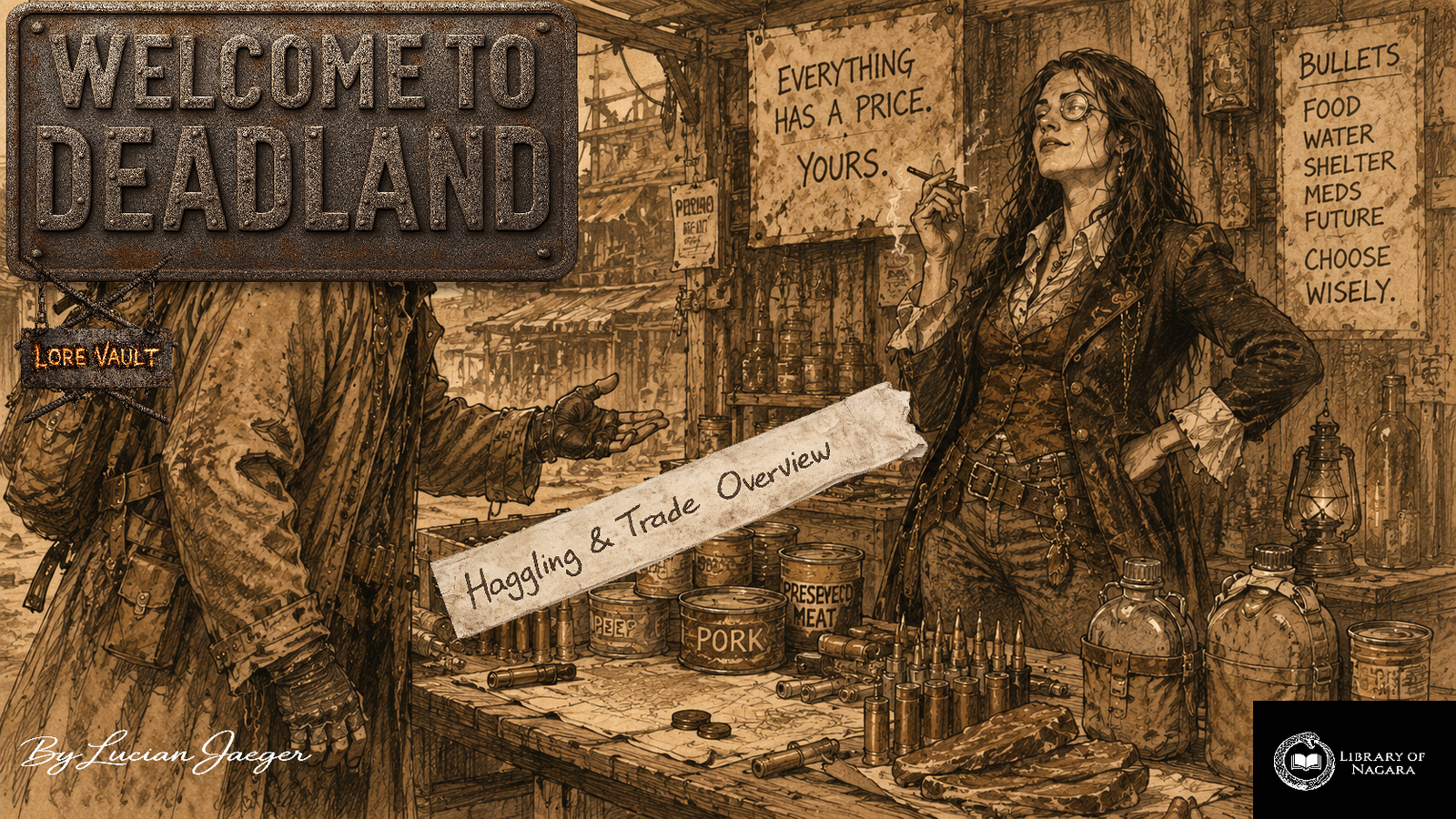
Economics & Trade: Haggling and Trade
In the Deadland, trade is not a matter of fixed prices, clean counters, or polite market stalls. It is survival measured against hunger, distance, danger, reputation, and whatever a person can afford to lose.
There is no centralized economy binding the cities together. Each city produces what it can, hoards what it must, and trades for what it cannot make on its own. Outside the walls, outposts, caravans, Deadlanders, Roadfolk, mercenaries, smugglers, and scavengers keep goods moving through a continent that would otherwise starve in isolation.
Trade begins with need. A sack of coal, a strip of clean cloth, a working tool, a night behind a wall, a map to water, or a handful of ammunition can all become the difference between surviving another week and dying badly before dawn.
Trade
Most trade begins with barter. Goods are exchanged directly for other goods or services, especially when both sides have something the other wants. A scavenged radio might be traded for coal. A day’s labor might earn food and shelter. A hunter might exchange fresh meat for tools, medicine, or ammunition.
When barter is not enough, the Deadland falls back on practical currency. Bullets are the most common trade medium because they are useful everywhere. They can buy food, hire muscle, pay for shelter, or keep someone alive when the deal goes wrong. Old-world coins are rarer and usually reserved for larger exchanges, long-term wealth, or high-value purchases.
Trade is shaped by place. Food is cheaper where livestock and fishing are common. Weapons are easier to buy near military or industrial cities. Machinery, repair parts, fuel, medical supplies, and old-world relics all rise or fall in price depending on where they are found, how dangerous they were to recover, and how badly someone needs them.
Haggling
Haggling is expected. A price spoken aloud is rarely the final price. Traders bargain, test each other, bluff, threaten, flatter, and read the situation before settling.
A desperate buyer pays more. A starving caravan pays more. A wounded traveler pays more. A trader with options pays less. Someone with a reputation for violence, skill, or reliability may receive better prices — or worse ones, depending on who is across the table.
Deadlanders do not treat value as fixed. They read tone, urgency, risk, and context. A casual offer for food or shelter is understood differently from a heavy offer attached to a dangerous job, rare salvage, or infected bounty. The number matters, but the situation tells the rest.
This makes trade in the Deadland less like commerce and more like a language. People learn to hear what is being offered, what is being hidden, and what kind of danger sits behind the price.
In the Deadland, a bad bargain can leave a person hungry. A stupid bargain can leave them unarmed. The worst bargains are the ones that look fair until the road proves otherwise.