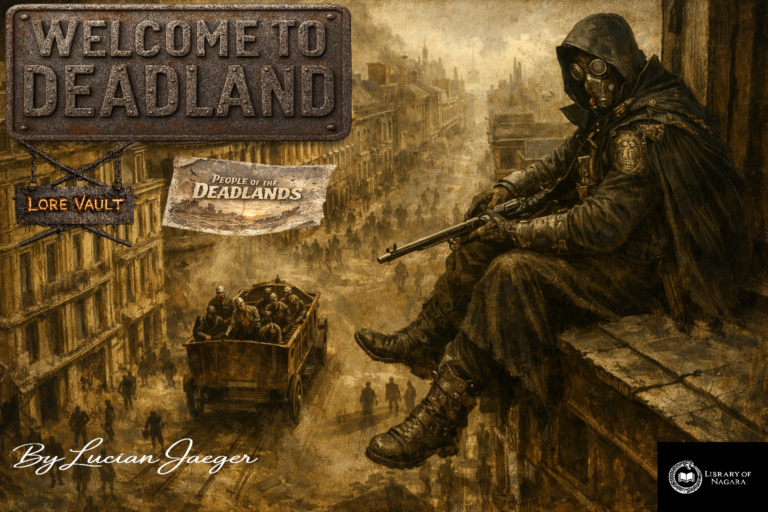
People of the Deadlands:
In the Deadlands there are four types of people:
City Folk: Those who live behind city walls, never leaving. Even their city guards
won’t venture out unless forced. Every walled city it’s own culture and every
Outpost it’s own subvariant culture.
Traders: Those who brave the roads, running commodities and supplies between
cities and outposts to make a living.
Mercenaries: Those who don’t have what it takes to survive the world alone, so
they group up. They protect traders, keep roads clear, and burn infected nests along
the routes — but actively avoid venturing into the Graveyards (ruins of the pre
collapse civilization) unless there’s a big payout.
Deadlanders: The peaks of human adaptability… or stubbornness. Deadlanders
are those who survive braving the world alone and live long enough to talk about
it. They often live in Graveyards, only venturing out to trade salvage with walled
cities or to take jobs for Graveworkers, the world’s bounty franchise offices.
Traders, Mercenaries, and Deadlanders share a common road culture separate from
city folk, known as “Civic Duty.”
Civic Duty is a set of rules and customs by which they keep each other alive:
1. Road Clearing: Deadlanders and Mercenaries keep the roads as clear as
they can and burn roadside nests. In return, Traders give them fair trade and
even toss in a little extra while on the road. But within city walls, bring your
A-game negotiation skills.
2. Paying It Forward: In the event a trade wagon, a Deadlander, or a
Mercenary family is on the verge of death or otherwise hindered, they leave
what can’t be carried for others who might have a better shot. If they take,
they leave something behind in return.
Example: A water wagon gets overrun; the Traders are either dead or forced to
flee. Later, a Mercenary family running a steamtruck uses the left-behind water to
top off their boiler — in return, they leave a sack of coal or a box of ammo. A
Deadlander comes along, restocks ammo he can use (swapping it for rounds he
can’t), tops up his water supply, and leaves behind a note on local nest locations to
be watched or cleared.
3. All brothers and sisters of the road should anounce them selves with Civic Duty to be recognised as friend and wait until the gesture be returned.
4. Non-Compliants to Civic Duty and shared survival, bandits, slavers, are to me such an example of that the next one gives pause before pulling at trigger.
Naming Conventions
Traders, Mercenaries, and Deadlanders all have their own internal cultures.
Traders:
Use a first and last name, followed by “of [Company Name].”
Example: Henrick Lox of Long Road Trade Company
Traders only announce themselves with company name to other traders as a sign of
position within the trade hierarchy.
The wording is important:
To another trader: “I’m Henrick Lox of Long Road Trade Company,” establishing
position.
To a customer: “I’m Henrick Lox, I’m with Long Road Trade Company.”
To traders, the reputation and ability of the owner grow the company’s name —
and that’s what people respond to.
Mercenaries:
Keep their first and last name as a reminder of origin, followed by a family name.
Example: Justin Steele — “Steel Family.”
The name declares both the individual and the family they belong to. It’s not
uncommon for merc families to refer to one another as brothers and sisters. When
mercs from different families converse, they drop the last name and use first name
plus family name:
“You’re Justin, Steel Family, right?”
Among mercenaries, the group contributes to the reputation of the family.
Deadlanders:
By contrast, drop their last name entirely. They use a first name and a title. Titles
are earned, given by others based on reputation, rumors, or achievements that culminate as recognition of self.
Reputation, rumors, achievement put together with the a core trait or traits observed of the Deadlanders Self..
Examples:
• Jennie “The Scalpel”: earned for the “medical experiments” she ran on
bandits and slavers, contributing to Graveworker and Techport medical
knowledge of the fungal parasite, but she is also calculated, precise, elegant.
• Mallory “The Mad”: A psychotic Deadlander who attempted “alchemy” by
using human and animal infected bites on bandits and slavers to try and create
hybrids. He discovered they’re the same parasite, the host’s primal instinct
determines behavior — much to his disappointment, but a contribution
nonetheless.
• Selena “The Dancer”: named for her history as a dancer in Dunmere,
the way she fights, often with a rope dart and her playful cat like sadist nature.
A Deadlander with no title refers to themselves by first name only.
Among Deadlanders, there’s an unspoken custom to erase origin — to become a
part of the Deadlands itself, the place of origin now longer wanted them, so sever the tie where so it holds no bearing over you and only the self remains.
Every title is a look into who they are.