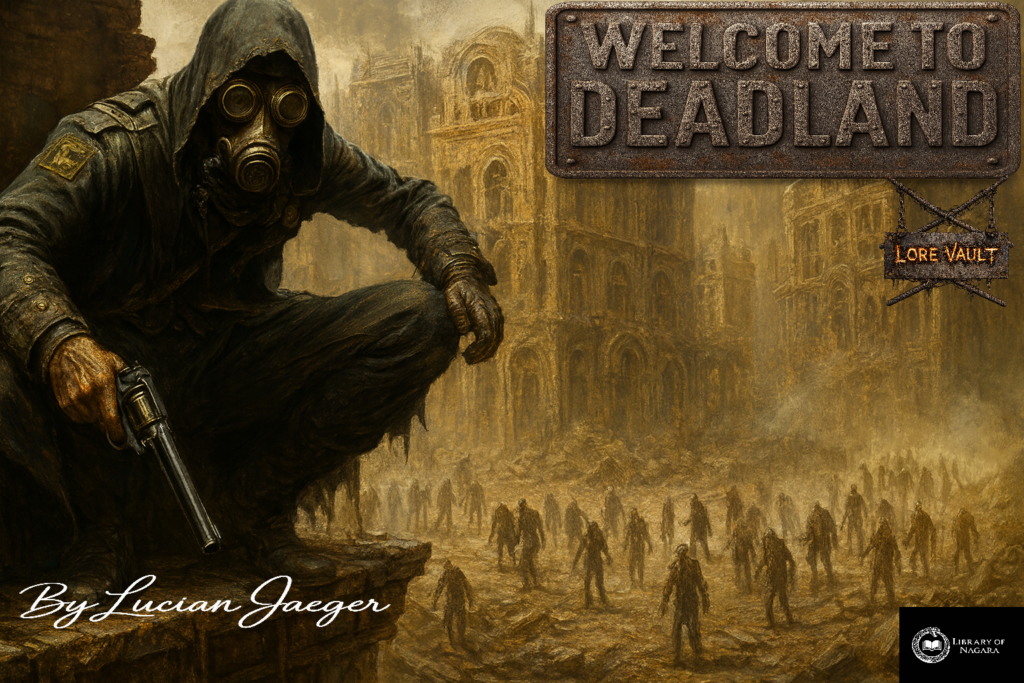
Welcome to Deadland
Welcome to Deadland
A world forsaken. A world that does not end, only forgets you ever lived in it.
The Continent The Local’s Call Deadland
Greetings, Pup. Stretching over 2,400 miles from salt-bitten coasts to sun-scorched desert cores, the Deadlands is a continent where life clings to the edges of ruin. It’s a land shattered not by bombs or war, but by rot, by Cordyceps Mortis, a fungal parasite that hollowed out cities, minds, and the very ground beneath them. What was once a cradle of human civilization has become its proving ground.
The continent isn’t truly dead. It breathes, spores drifting on humid winds, nests pulsing in ruined churches, forests whispering with the limbs of things that used to be men and beast. But to those who live here, it feels dead. Forgotten. Unholy. Alive in all the wrong ways.
Most of humanity has retreated behind the walls of eighteen fortified cities, each culturally and politically distinct, locked into a cold truce born of mutual dependence and shared dread. Trade moves between them in caravans, guarded by mercenaries and driven by the desperate. Beyond those walls, past the scrublands and shattered highways, lies the true Deadland, open, fungal, and almost always fatal.
Cordyceps Mortis — The Living End
The infection is not a disease. It is a lifecycle. A fungal parasite bound to two instincts: spread and consume. Bites and deep wounds plant hyphae in flesh. Spores cling to lungs in damp ruins. Scratches sometimes fester—sometimes rot you from within. In the desert, spores die in the sunlight. But in forests? In basements? In the chest of a fallen comrade? They bloom.
Infection moves in stages: fever, tremors, graying eyes, tendrils threading under your skin… and then? It reaches the brain. You join the Shufflers. Runners. Howlers. Maybe join the specialized abominations that mimic memory, mock intelligence, and move with purpose. Eventually, Some of the infected collapse into a nest. Their final act: to breathe spores into the world the fungus has its own eco-system it lives by, contributing to the war of attrition… Until something burns them, breaks them, or joins them trying.
Cities, Castes, and the Cold Truce
There is no “nation” in the Deadlands. Each city is a kingdom unto itself, some ruled by oligarchs, others by technocrats, cartels, priests, or warlords. Each holds a piece of the continent’s survival puzzle: saltwater fish from Marinus, guns and ammo from Eisenkrone, livestock from Valmontaine, black market commodities from Dunmere.
No one city can survive alone. And so they don’t fight. Not officially. Assassins and intrigue are common. But war? War would starve them all. So all regardless of belief they operate under two simple unspoken rules “Don’t rock the boat!” “Don’t risk the whole!” dreams of conquest are usually met by death at the hands of your own followers, shaking hands with those you hate is better than starvation and collapse. That doesn’t stop cities changing internally for example, as long as the trade routes and resources stay open cities stay out of each other business.
Outposts dot the roads between cities, some are trade hubs, others merc camps, research stations, or resource towns. They serve as rest stops, refugee camps, and death traps. They also keep the Deadland just connected enough to function.
.
Deadlanders — Blades in the Dust
Some reject the cities. Most are cast out for population control. The ones who survive become Deadlanders or Mercs, loners, salvagers, drifters. Deadlanders live in the Graveyards (Former civilizations fallen mega cities) where mercs won’t go. They burn nests, trade in pre-collapse tech, and carry scars that speak louder than names. Mercs work in teams 3 to 5, live city to city, outpost to outpost on the road protecting caravans or taking jobs that don’t require them venturing off the road. Unless the pay is worth dying for. Deadlanders by contrast live and work alone, sometimes operating in pairs, rare occasions with Merc teams who took a job into the Graveyards.
They don’t trust easily. Deadlanders, Merc and Traders have their own rules, customs and “Civic Duty” mantra they all follow as those who live outside City walls.
Bullets are currency. Coins are for luxury. Trust is worth more than both.
Fire, Steel, and Steam
Nothing in the Deadlands is clean. Guns are hybrid or reverse engineered. Steamcycles, the armor-plated wagons, the gear-driven trucks puffing coal smoke and ichor fumes into the sky, some by horse wagons.
Coal is common. Oil is rare. Fungal ichor burns hot, fast… leaves a toxic trail behind you and makes you smell worse then bad meat tins, if you don’t choke to death.
.
A World That Hates You Quietly
The biomes shift like moods: deserts mixed with sand, dust and dead spores plateaus under blinding sun, jungle ruins whispering with wet breath, mist-laced forests that trick the ear. At night, spores rise like breath from a dying god, the slow war of attrition creeping further. Fresh water sources are death traps—because where there’s water, there’s life. And where there’s life… the fungus waits in the water itself. Even the weather betrays you. Fog hides the infected, protects spores from the sun. Rain spreads spores. Storms wake nests. The safest path is the one where you can find a spare gun. The most dangerous? The one that feels too quiet.
This Is the Deadlands
A land where mercy is scarce, for the un-initiated. Where trade means survival. Where cities cling to walls and Deadlanders adapt and endure it all. This is not your world. But if you’re reading this, maybe it will be. Load your weapon. Check your mask. Keep the noise down. You don’t conquer the Deadlands. You endure it and… Never wake it.
One of the best ways to experience a culture, the theme of a world is through music.
Step on in.
“The Deadlands never sleeps, but it dozes… and It doesn’t like being woken.”